
Pictured on the right is a table leaf that belonged to John Terrell Rogers, James Harvey’s father. This table would have taken center place in the dining room at Bellevue, the family’s palatial Antebellum mansion, located in Society Hill, South Carolina. This artifact is featured in the architectural elements gallery at the Darlington County Historical Commission and Museum, along with the carriage block that was placed in front of it.

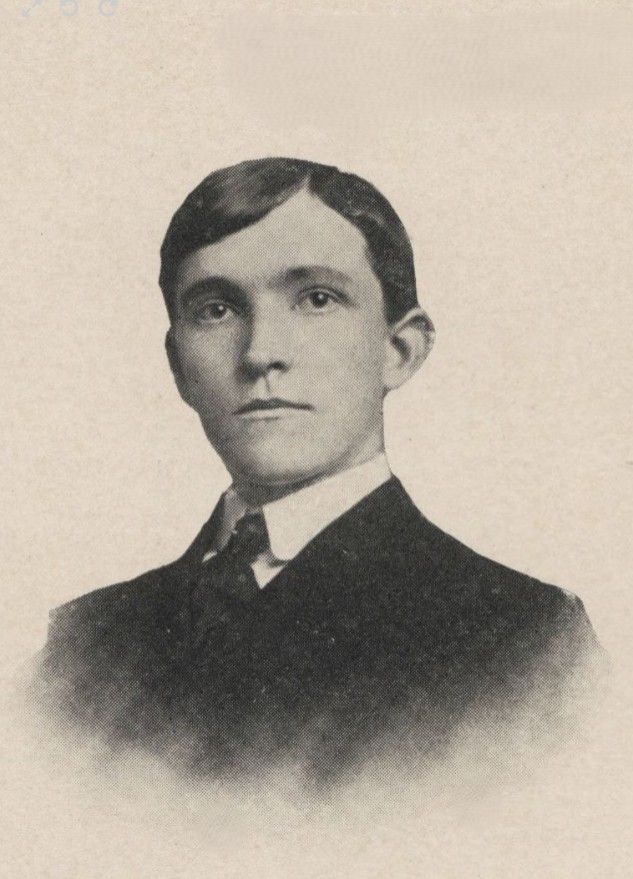
James Harvey Rogers (September 25, 1886 – August 13, 1939) was a prominent American economist who served as Sterling Professor of Economics at Yale University from 1931 until his death. A close disciple of Irving Fisher and influenced by Vilfredo Pareto, Rogers is often regarded as an early or “proto-Keynesian” thinker whose work linked economic theory with public policy.
Rogers was born into a long-established South Carolina family with deep colonial roots along the Pee Dee River. His father, John Terrell Rogers, had served in the Confederate Army and later became a planter near Society Hill.
He received his early education at St. David’s Academy and entered the College of South Carolina (now the University of South Carolina) in 1904. There, he completed degrees in both arts and sciences, as well as a master’s degree in mathematics and astronomy by 1907. After a brief period teaching, he pursued further study at Yale University and the University of Chicago before ultimately returning to Yale, where he shifted his focus to political economy.
A formative period in Rogers’s intellectual development came during a fellowship year in Europe in 1914–1915. He studied directly under the influential economist Vilfredo Pareto in Switzerland, an experience that shaped his analytical methods and reinforced his interest in combining theoretical knowledge with real-world observation. He completed his doctoral dissertation in 1916.
During World War I, Rogers contributed to the national effort as a statistician with the U.S. Council of National Defense and later served as a first lieutenant in the Ordnance Reserve Corps. After the war, he participated in federal research on wartime prices and briefly worked with the Red Cross in Europe, gaining valuable insight into economic organization and global conditions.
Rogers’s academic career included positions at the University of Missouri and Cornell University before he returned to Missouri as a full professor. In 1931, he was appointed Sterling Professor at Yale, one of the highest honors in American academia.
In addition to his academic work, Rogers played an active role in government and international affairs. He advised President Franklin D. Roosevelt’s administration on monetary and fiscal policy during the early New Deal, served as a U.S. Treasury representative in the Far East, and was a member of the Economic Committee of the League of Nations.

Left to right: Henry Morgenthau Jr., Eugene R. Black, George F. Warren, Samuel Rosman, and James Harvey Rogers attend as President Franklin D. Roosevelt signs the Gold Reserve Act into law, January 30th, 1934.
Rogers’s career was cut short on August 13, 1939, when he died in an airplane crash near Rio de Janeiro while on an economic mission to Brazil. In accordance with his wishes, he was buried in Society Hill, South Carolina, in the graveyard of Welsh Neck Baptist Church.
His legacy endures through his contributions to economic thought, his influence on public policy, and honors such as the James Harvey Rogers Chair of Money, Credit, and Banking at the University of Missouri, as well as archival collections preserving his work at Yale University.
